HyWaves: Economics Is At The Core Of What We Do
As any economist will tell you, the best value option will usually win in the market. That’s why at HyWaves, we are focused on technologies to reduce cost, specifically the upfront CAPEX. Reducing the required investment to build hydrogen plants lowers the barrier to entry by removing the unnecessary finance burden of building conventional plants.
HyWaves has been working with a large hydrogen Tier 1 supplier to model the economic benefits of the company’s system on an example real-life project. This life-cycle analysis compares three different power architectures for a 5 MW solar-powered alkaline electrolysis plant and demonstrates that HyWaves’ H2Top DC-native power management technology delivers the lowest hydrogen production cost while also reducing upfront capital investment.
Looking Beyond Electrolyser Efficiency
Solar PV naturally produces DC electricity, while electrolysers also operate using DC power. Conventional hydrogen plants unnecessarily convert this electricity multiple times between DC and AC before it finally reaches the electrolyser.
Every conversion stage introduces additional equipment, energy losses, maintenance requirements and replacement costs throughout the lifetime of the project.
H2Top takes a fundamentally different approach by creating a DC-native architecture that transfers power directly from the solar array to the electrolyser, eliminating much of the conventional power electronics required in traditional AC-coupled systems.
The result is a simpler, more efficient and lower-cost power architecture.
27% Lower Levelised Cost of Hydrogen was found for a particular case study using the data from the hydrogen Tier 1 supplier
The study compared three architectures over a 25-year project life:
- Conventional AC-coupled system using rectifiers
- HyWaves H2Top DC-native architecture
- Central DC-DC converter architecture
Using a full Net Present Value (NPV) LCOH methodology, the results were clear:

This represents a 27.3% reduction in hydrogen production cost compared with a conventional AC architecture, and an additional 10% improvement over a central DC-DC solution.
Lower Capital Cost from Day One
Reducing LCOH starts with reducing capital expenditure.
Despite incorporating additional bipolar current collectors within the electrolyser stack, H2Top still achieved the lowest overall installed CAPEX because it removes much of the costly AC power conversion equipment, associated switchgear, cabling and installation work.
For the 5 MW reference plant:
- Conventional AC architecture: £5.92 million
- Central DC-DC architecture: £5.25 million
- HyWaves H2Top: £5.08 million
This delivers an upfront capital saving of more than £840,000 compared with a conventional AC-coupled design.
Reduced Lifetime Maintenance Costs
The benefits extend well beyond the initial installation by reducing the maintenance expenditure and plant downtime. Traditional AC systems require replacement of an entire fleet of string inverters, while central DC-DC systems require replacement of the main converter during the 25 year life of the plant. In contrast, the H2Top architecture only requires replacement of low-cost switching components that can be replaced while the system is in operation with zero downtime.
Improved Electrical Efficiency
The analysis represents the conventional AC architecture using typical rectifier and inverter efficiencies, resulting in approximately 11.7% electrical losses before energy reaches the electrolyser.
These assumptions closely align with HyWaves’ real-world field testing, where H2Top demonstrated approximately 15% higher whole-system performance than an equivalent AC-connected system under variable solar conditions.
Higher electrical efficiency means more hydrogen is produced from every kilowatt-hour generated by the solar array, directly reducing the cost of hydrogen production.
A More Resilient Business Case
Sensitivity analysis showed that project economics are primarily driven by capital cost and solar energy production, with H2Top maintaining the lowest LCOH across a wide range of assumptions:
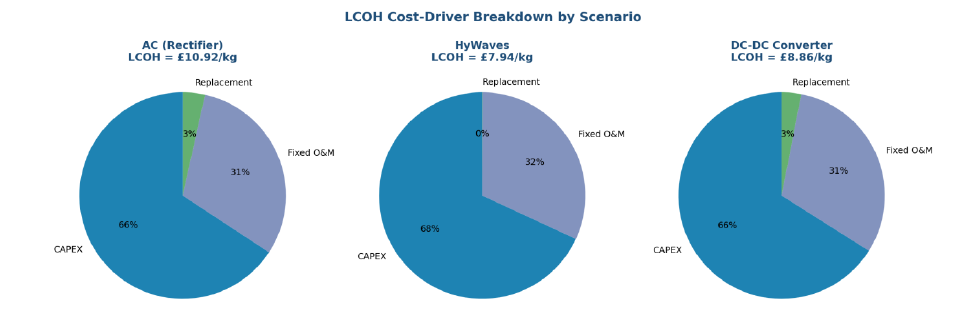
Levelised Cost of Hydrogen by scenario (full NPV method)